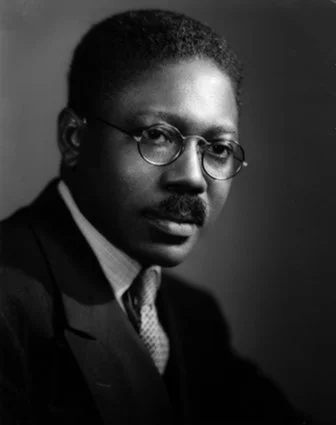
Aaron Douglas (1889-1978)
Born in Topeka, Kansas, in 1899, Aaron Douglas emerged as the leading visual artist of the Harlem Renaissance, shaping its aesthetic identity through a distinctive synthesis of modernism and African diasporic imagery. After early studies at the Detroit Institute of Arts and earning a BFA from the University of Nebraska in 1922, Douglas initially worked as a teacher before relocating to New York in 1925, drawn by the intellectual and cultural momentum of Alain Locke’s New Negro movement. There, his encounter with the German-born artist Winold Reiss proved fruitful, encouraging him to draw upon African forms and themes as the foundation of a new, modern visual language.
Douglas’s immediately recognizable mature style centers on silhouetted figures, rhythmic patterning, and radiating bands of light that structure space both formally and symbolically. These compositional devices, often organized in concentric arcs, guide the viewer through layered narratives of African American history, from ancestral origins to modern urban life. Rather than depicting specific events, Douglas constructed visual allegories, producing images that are at once historical, spiritual, and forward-looking.
This language found its fullest expression in his mural cycles, most notably the 1934 commission for the Countee Cullen Branch of the New York Public Library (now the Schomburg Center for Research in Black Culture). Across these panels, Douglas charted a sweeping vision of Black history through carefully orchestrated color harmonies and overlapping planes, achieving a balance between clarity of design and atmospheric depth. His work in illustration, appearing in publications such as Opportunity and The Crisis, further extended this visual vocabulary, helping to define the graphic identity of the Harlem Renaissance.
Beyond his artistic production, Douglas played a crucial institutional role in advancing African American art. A recipient of two Rosenwald Fellowships, which supported his travels to France, Haiti, and the American South, he also served as president of the Harlem Artists Guild, advocating for greater inclusion of Black artists within federal art programs. In 1939, he founded the art department at Fisk University, where he remained a central figure in arts education until his retirement in 1966, shaping generations of artists.
Douglas died in Nashville, Tennessee, in 1979. His work is held in major institutional collections, including Fisk University, the Corcoran Gallery of Art, and the de Young Museum, and has been the subject of significant scholarly reassessment, most notably in the exhibition Aaron Douglas: African American Modernist (Smithsonian American Art Museum, 2008). Today, he is recognized not only as a participant in the Harlem Renaissance but also as the artist who gave it its enduring visual form.
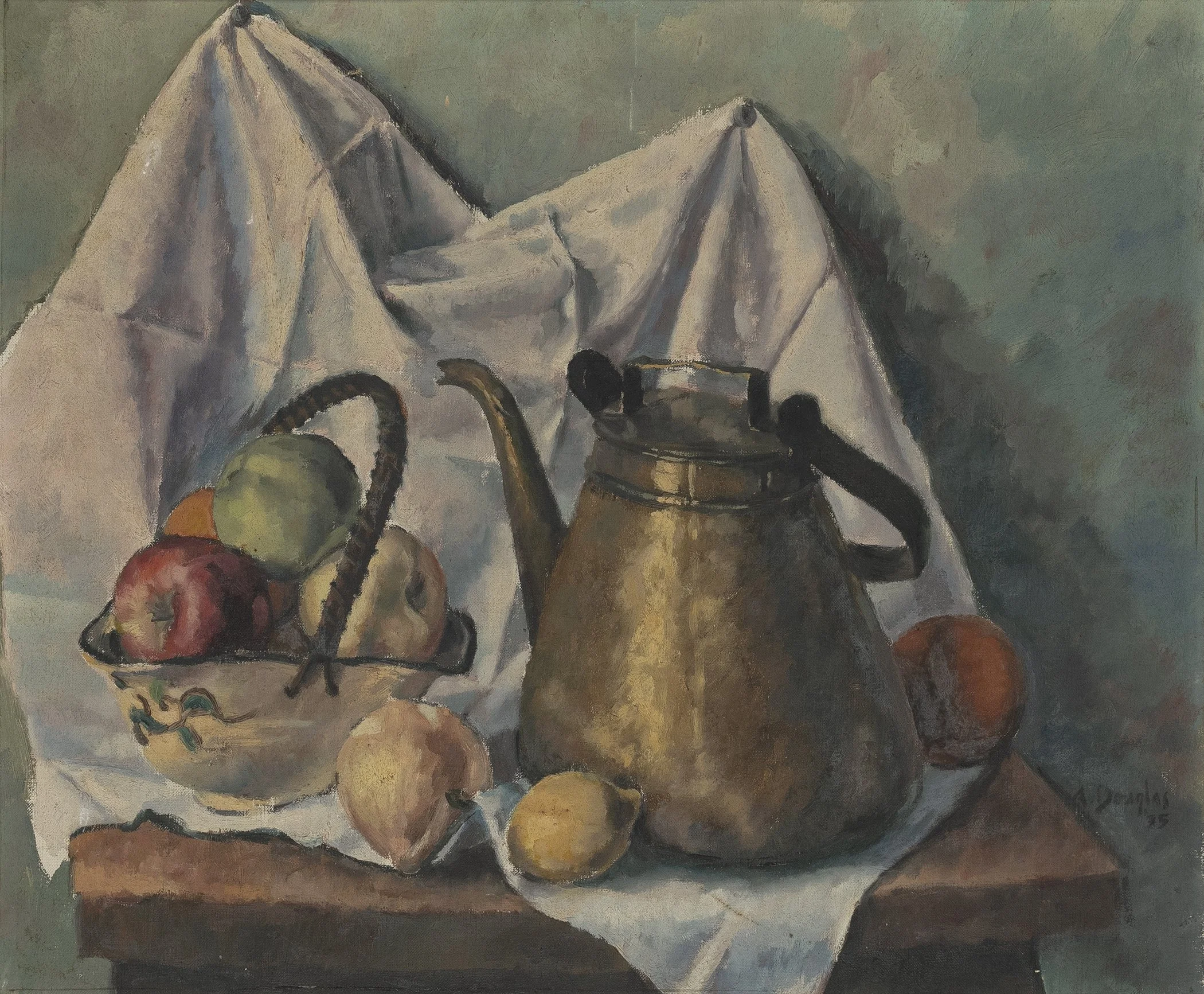
Brass Jug, 1935
oil on canvas
20 x 24 inches
signed; signed and titled verso
Selected Exhibitions
Negro in Art Week, exhibition of primitive African sculpture, modern paintings, sculpture, drawings, applied art, and books; Art Institute of Chicago, IL. 1927
Exhibition of productions by Negro artists: presented by the Harmon Foundation at the Art Center; Harmon Foundation, NY, 1928, 1931, 1933
Caz Delbo Gallery, NY, 1933 (Douglas’s first solo exhibition)
New York Public Library, 115th St. Branch, 1936
Exhibition of Contemporary American Painting; Findlay Galleries, NY, 1937
An Exhibition of the Harlem Artists Guild; New York Public Library, 115th St. Branch, 1937
Contemporary Negro Art; Baltimore Institute of Art, MD, 1937
Art of the American Negro; Howard University Gallery of Art, Washington, DC, 1937
Exhibition of the Art of the American Negro (1851-1940); Tanner Art Galleries, Chicago, IL, 1940
The Negro Artist Comes of Age: A National Survey of Contemporary American Artists; Albany Institute of History and Art, NY, 1945
People’s Art Center, St. Louis, MO 1947
AARON DOUGLAS: Exhibition of Paintings; Fisk University Art Gallery, TN, 1948
Chabot Gallery, Los Angeles, CA, 1949
Invisible Americans: Black Artists of the 1930s; Studio Museum in Harlem, NY, 1968
Retrospective Exhibition: Paintings by AARON DOUGLAS; Carl Van Vechten Gallery, Fisk University, TN, 1971
Two Centuries of Black American Art; Los Angeles County Museum of Art, 1976
Tradition and Conflict: Images of a Turbulent Decade 1963-1973; Studio Museum in Harlem, NY, 1985
The Blues Aesthetic: Black Culture and Modernism; Washington Project for the Arts, Washington, DC, 1989
Narratives of African American Art and Identity: The David C. Driskell Collection;University of Maryland Art Gallery, College Park, 1998
Black New York Artists of the 20th Century: Selections from the Schomburg Center Collections; Schomburg Center for Research in Black Culture, NY, 1999
Syncopated Rhythms: 20th-Century African American Art from the George and Joyce Wein Collection; Boston University Art Gallery, MA, 2006
Visions of America: A Black Perspective; ACA Galleries, NY, 2011
Modern Black Culture: The Art of Aaron Douglas; Ackland Art Museum, University of North Carolina, Chapel Hill, 2022
Aaron Douglas: Sermons; SCAD Museum of Art, Savannah, GA, 2022-2023