Allan Rohan Crite (1910-2007)
Born in North Plainfield, New Jersey in 1910 and raised in Boston, Allan Rohan Crite devoted his long career to the depiction of everyday Black life and spiritual experience with a quiet, unwavering conviction. He studied at the School of the Museum of Fine Arts, Boston, graduating in 1936, and later earned a degree from the Harvard Extension School in 1968. While still a student, Crite participated in the Public Works of Art Project and the Works Progress Administration, and in 1936 his work was included in the Museum of Modern Art’s landmark exhibition New Horizons in American Art, signaling early institutional recognition.
Crite’s artistic vision was guided by a singular aim: to represent African American life not as spectacle or social problem, but as a dignified and integral part of the human experience. His early paintings of Boston’s South End neighborhoods—populated by figures engaged in daily routines—reflect this commitment, presenting scenes of community, work, and leisure with clarity and restraint. By the 1940s, however, Crite began to shift away from large-scale oils toward drawings and watercolors, developing a linear style informed in part by medieval and early Renaissance art. This transition marked a deepening of his interest in structure, rhythm, and spiritual narrative.
Across his mature oeuvre, Crite increasingly turned to religious subject matter, reimagining Christian themes through a distinctly Black cultural lens. Biblical scenes are not set in distant, historical landscapes, but are instead infused with contemporary presence and asserting the continuity of faith across time. His compositions often feature flattened space, rhythmic line, and a careful orchestration of figures that recalls both illuminated manuscripts and early panel painting, while remaining rooted in modern experience.
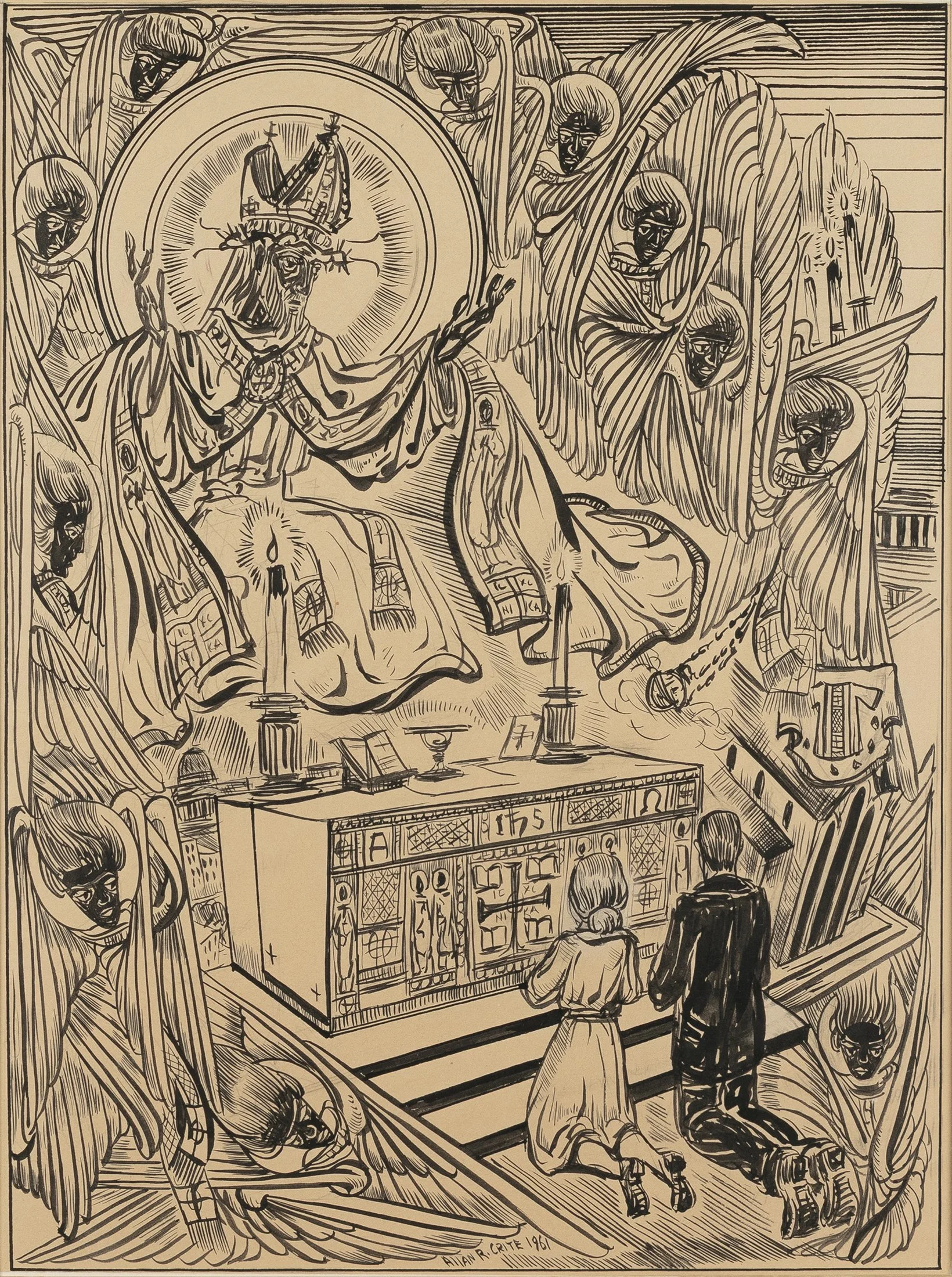
The present work exemplifies this synthesis of sacred imagery and personal vision. A central, enthroned figure, haloed and surrounded by a host of angels, presides over a scene of devotion, while two kneeling figures occupy the foreground in quiet prayer. The composition is dense yet ordered, structured through interlocking lines and repeating forms that guide the viewer’s eye across the surface. Crite’s use of line is particularly expressive, defining not only form but also movement and spiritual energy. The presence of African American figures within this sacred space reflects his enduring commitment to locating Black identity within the broader framework of Christian history, transforming traditional iconography into something both immediate and deeply personal.
In addition to his studio practice, Crite worked for over three decades as a technical illustrator at the Boston Naval Shipyard, maintaining a parallel career that grounded his artistic life. His religious imagery reached a wide audience through illustrations produced for church publications in the 1970s and 1980s, further extending his influence beyond the gallery setting. His work is held in major institutional collections, including the Smithsonian American Art Museum and the Museum of Modern Art, New York. Crite died in Boston in 2007, leaving behind a body of work defined by its humility, discipline, and profound sense of purpose.
“Historian, diligent researcher, theologian, teacher, philosopher, simple believer, Allan Crite is a bit of all these things, but most of all he is an artist whose agile mind and equally agile hands have never tired of creating a world of images simultaneously local and global, divine and secular, poetic yet unsentimental. His art, marked by narrative and documentary characteristics, retains a simple beauty, simply presented.”
Edmund Barry Gaither, essay to the catalogue accompanying the exhibition, Allan Rohan Crite, Artist-Reporter of the African American Community; Frye Art Museum, 2001, 23.
untitled, 1961
ink and pencil drawing on cream paper
12-1/2 x 9-1/4 inches
signed and dated
Selected Exhibitions
Exhibition of the Art of the American Negro (1851-1940); Tanner Art Galleries, Chicago, IL, 1940
American Negro Art, 19th and 20th Centuries; Downtown Gallery, NY, 1942
Third Annual Exhibition of Paintings, Sculptures, and Prints by Negro Artists: The Two Generations; Atlanta University, GA, 1944
The Negro Artist Comes of Age: A National Survey of Contemporary American Artists: Albany Institute of History and Art, NY, 1954
The Evolution of Afro-American Artists; 1800-1950; City College, CUNY, 1967
Jubilee: Afro-American Artists on Afro-America; Museum of Fine Arts, Boston, MA, 1975
Museum of the National Center of Afro-American Artists, Boston, MA, 1975
Afro-American Historical and Cultural Museum, Philadelphia, PA, 1978
Ritual and Myth: A Survey of African American Art; Studio Museum of Art, NY, 1982
Massachusetts Masters: Afro-American Artists; Museum of Fine Arts, Boston, MA, 1988
Narratives of African American Art and Identity: The David C. Driskell Collection; University of Maryland Art Gallery, College Park, MD, 1998
The Great Migration: The Evolution of African American Art, 1790-1945; Taft Museum of Art, Cincinnati, OH, 2000
Allan Rohan Crite: Were You There, Washington National Cathedral, Washington, DC, 2003
Visual Exegesis: Religious Images by African American Artists from the Jean and Robert E. Steele Art Collection; Institute of Sacred Music, New Haven, CT, 2008
My Soul Looks Back and Wonders: The Black Experience in Illustration, 1773-2010; Society of Illustrators, Inc, NY, 2010