Hughie Lee-Smith (1915-1999)
Lee-Smith was born in Eustis, Florida in 1915, and raised in Atlanta and Cleveland, Ohio. His mother encouraged his growing talent by enrolling him in an art class for gifted students at the Cleveland Museum of Art. At twenty years old, he won a Scholastic magazine competition that allowed him to study at the Art School of the Detroit Society of Arts and Crafts. He also studied at the Cleveland Institute of Art (1938); and at Wayne State University (1952-1953), he studied art, theater, and dance.
Throughout his career, he taught at several distinguished institutions including the Karamu House, Cleveland (late 1930’s), Princeton Country Day School, NJ (1963-65), Howard University, WashingtonD.C. (1969-1971), and the Art Student’s League, NYC (1972-1987).
Lee-Smith was employed by the Ohio Works Progress Administration in1938-1939. At this time, he did a series of lithographic prints and painted murals at the Great Lakes Naval Station in Illinois. The Cleveland Museum recognized him for drawing in 1938 and for printmaking in 1939-1940. His early works were shown mostly in Chicago and Detroit; at the South Side Community Art Center, the Snowdon Gallery, and the Detroit Artist’s Market. He was a regular exhibitor at the National Academy of Design from 1959 to 1976. Lee-Smith’s work resisted easy categorization. Unlike many of his contemporaries, he turned inward, developing a visual language that merged elements of realism and surrealism to explore solitude, memory, and emotional distance.
Across his oeuvre, figures, often solitary, contemplative, and psychologically remote, occupy ambiguous, sparsely constructed environments. Rooftops, open lots, and undefined architectural spaces recur. These environments, stripped of narrative specificity, evoke a sense of suspension: time appears slowed, and human presence becomes introspective rather than social. His palette, typically muted and atmospheric, reinforces this mood.
Though widely respected during his lifetime, Lee-Smith did not receive a major retrospective until 1988, when the New Jersey State Museum organized a comprehensive exhibition of his work. Late recognition continued with exhibitions such as the 1997 presentation at the Ogunquit Museum of American Art, and in 1994, he was commissioned to paint the official portrait of New York City Mayor David Dinkins. Today, his work is held in numerous institutional collections, including the Detroit Institute of Arts and Howard University, and continues to be reevaluated for its singular contribution to twentieth-century American painting.
In 2013, the Muskegon Museum of Art in Michigan organized a solo exhibition of his work from the 1930’s and 40’s titled Hughie Lee-Smith: Meditations.
Selected Exhibitions
Howard University Gallery of Art, Washington, DC, 1955
Janet Nassler Gallery, NY, 1960, 1962, 1964
Forsyth Gallery, Ann Arbor, MI, 1966
30 Contemporary Black Artists; Minneapolis Institute of Arts, MN, 1968
Grand Central Art Galleries, NY, 1968, 1973
Bergman Galleries, Chicago, IL, 1969
Afro-American Artists: New York and Boston; Museum of Fine Arts, Boston, MA, 1970
Arwin Galleries, Detroit, MI, 1971
Two Centuries of Black American Art; Los Angeles: Museum of Art, 1976
Western Michigan University, Kalamazoo, MI, 1977
WPA and the Black Artist: Chicago and New York; Chicago Public Library, IL, 1978
Isobel Neal Gallery, Chicago, IL, 1987
June Kelly Gallery, NY, 1987-1989, 1991, 1994, 2000
HUGHIE LEE-SMITH: Cleveland Visionary, Malcolm Brown Gallery, Shaker Heights, OH, 1996
Yet Still we Rise: African American Art in Cleveland 1920-1970; Cleveland State University Art Gallery, OH, 1996
In Search of Missing Masters: The Lewis Tanner Moore Collection of African American Art; Woodmere Art Museum, Philadelphia, PA, 2009
African American Art: Harlem Renaissance, Civil Rights Era, and Beyond; Smithsonian Museum of American Art, Washington, DC, 2012
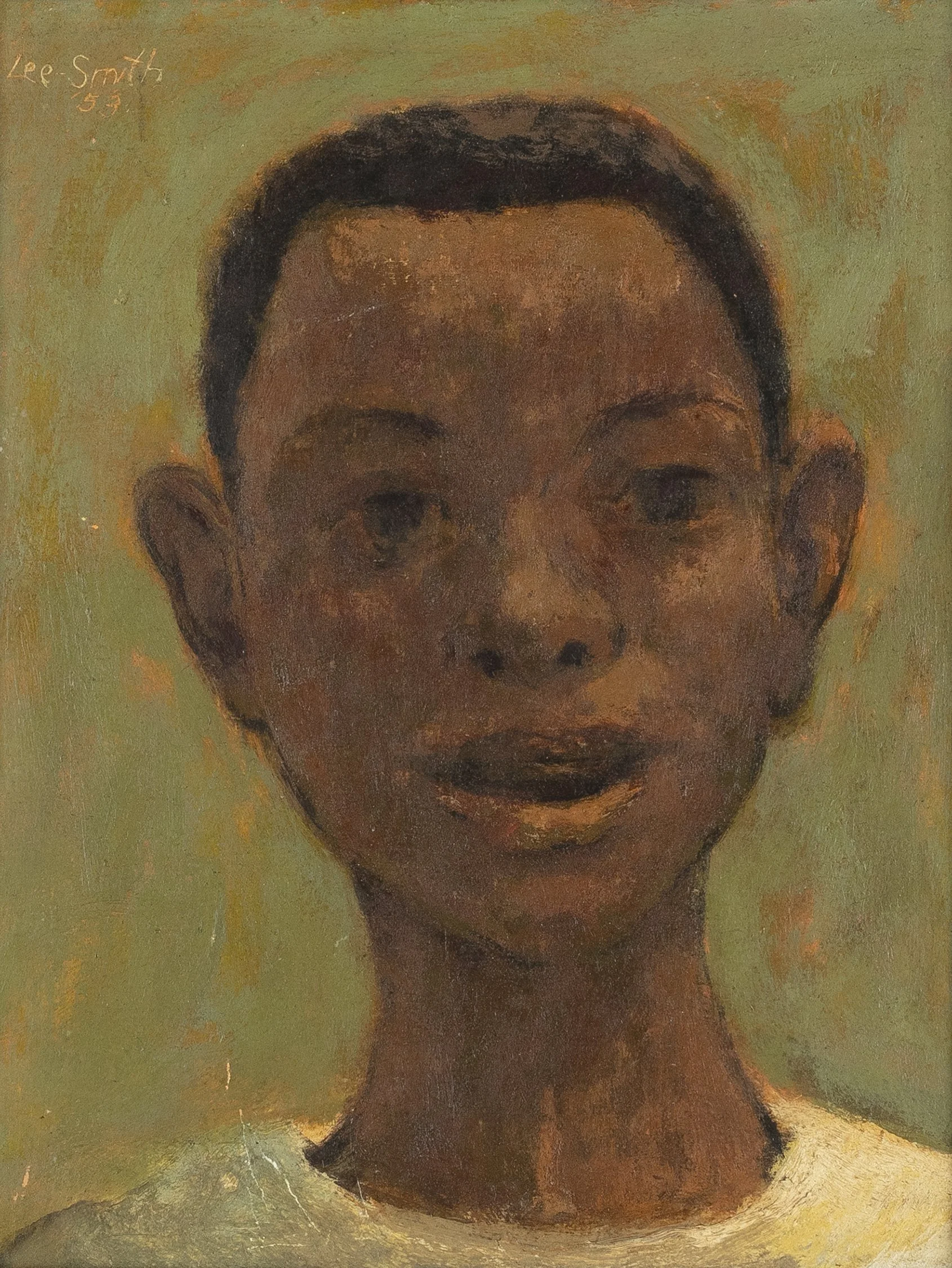
untitled, Young Boy, 1953
oil on board
10 x 8 inches
signed and dated