Jacob Lawrence (1917-2000)
Jacob Lawrence was born in Atlantic City, New Jersey in 1917 and raised in Philadelphia and Harlem. As a teenager, Lawrence had been uprooted from a childhood spent in Philadelphia when his mother brought her children to live with her in Harlem. She enrolled him in the after-school arts program directed by James Lesesne Wells. Lawrence’s mentor happened to be Charles Alston. He was able to create voraciously - he created elaborate paper mâché masks and three-dimensional models of Harlem. He read about master painters and focused his attention on patterns and colors.
Lawrence began attending high school, but quit after two years, worked odd jobs, and completed a stint with the CCC digging ditches during the Depression. He rediscovered Alston, who was now teaching in a WPA art center. Alston directed him to the Harlem Community Art Center, which Augusta Savage ran. She was able to get him admitted as an easel painter by the time he turned 21. He eventually found studio space with fellow artists Ronald Joseph, Romare Bearden, and Claude McKay. Lawrence was a regular at Professor Charles Seifert’s discussions of African and African American history at the 135th St. branch of the NYPL. At Seifert’s request, he attended an exhibition of West African sculpture at the Museum of Modern Art.
As an artist, Lawrence synthesized the events, meetings, discussions, experiences, and moments of his life onto the canvas and into his first narrative series (and the works to come). Between 1936 and 1938, he produced a series of works, The Life of Toussaint L’Ouverture. For him, it was not sufficient to produce one defining work on the life of such an important historical figure, so he created 41 paintings. Lawrence also created series on Frederick Douglass in 1939; Harriet Tubman, 1940; John Brown; and the Migration Series.
In 1939 the James Weldon Johnson Literary Guild sponsored an exhibition of his work at the Harlem YMCA - his first publicized one man show. The Toussaint L’Ouverture series was also shown at the Manhattan headquarters of the Catholic Interracial Council. Later, an entire room was set aside at the Baltimore Museum of Art for his series. This was unprecedented. Lawrence was well on his way to becoming the best known African American artist of his time.
Lawrence won three successive Rosenwald Fellowships. With the second, he traveled through the South, experiencing both rural and urban life, the result of which was his Migration Series. It was at this time that Edith Halpert of the Downtown Gallery began representing him. During WWII, he served in the Coast Guard, and was assigned to the first racially integrated ship in US history. In 1946, he accepted an invitation from Josef Albers to teach at Black Mountain College in North Carolina. He taught at many schools throughout his career, including the Art Students League, New School for Social Research, Pratt Institute and the University of Washington in Seattle, where he eventually retired.
Between 1986 and 1997, Lawrence created prints from The Life of Toussaint L’Ouverture Series, which is now in the collection of the Amistad Research Center at Tulane University in New Orleans. Lawrence translated 15 of these paintings into silk screen prints. At this later date, he was able change certain aspects of the work when adapting his original paintings to sets of silkscreen prints. The works were shown in the exhibition, To Preserve Their Freedom: Jacob Lawrence’s Toussaint L’Ouverture Serigraph Series, held at the Amistad Research Center, New Orleans in 2017.
His work is found in the collections of MOMA, NY; National Academy of Design, NY; National Gallery, Washington D.C.; The Phillips Collection, Washington D.C.; the Museum of Fine Arts, Boston; and many more.
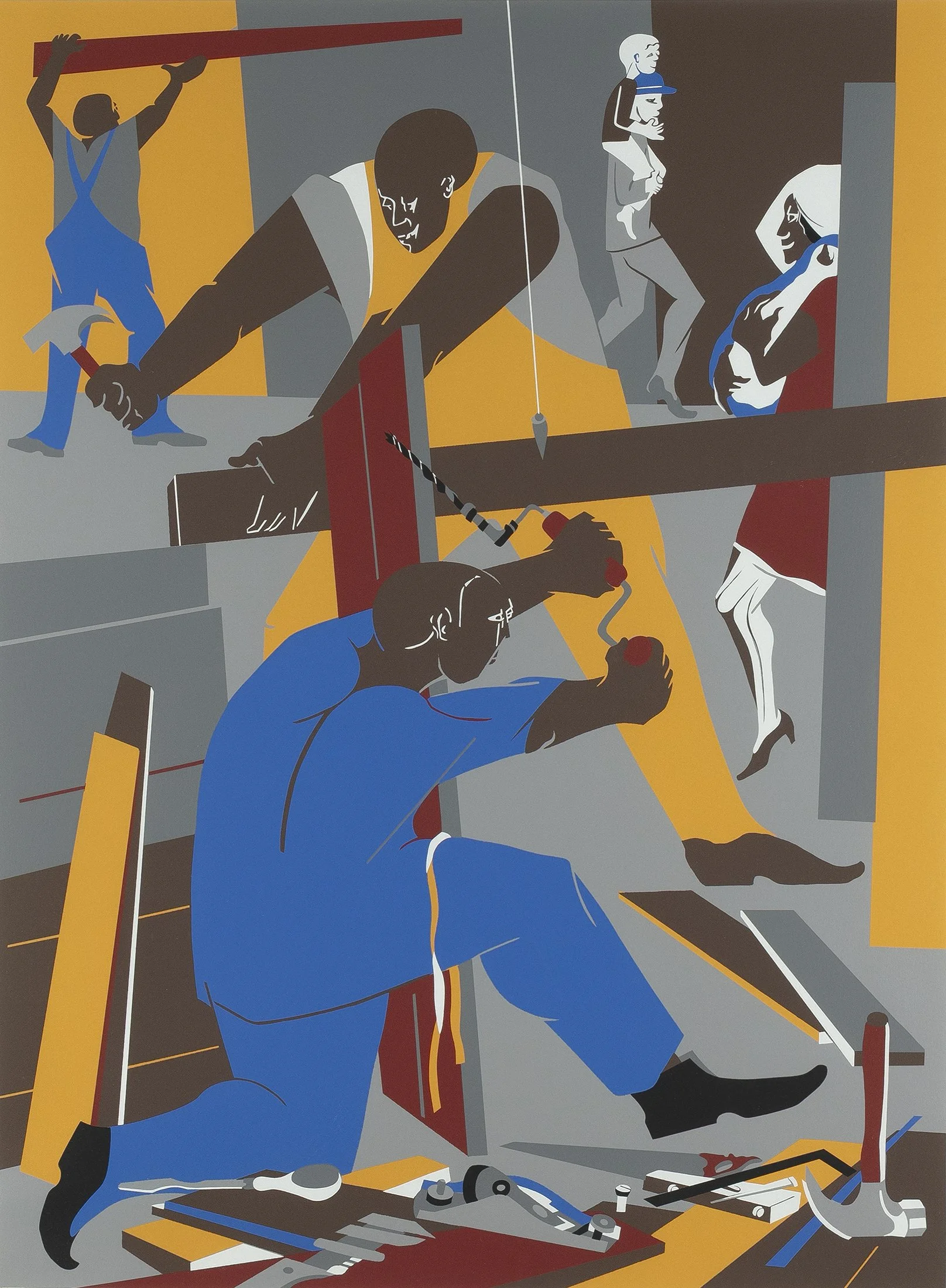
Builders No. 3, 1974
color screenprint
30 x 22-1/2 inches
signed, titled, dated, and numbered 131/150
“Created in the 1970s, Builders No. 3 draws on prints made during the Great Depression depicting organized labor. Those images, created in the 1930s, celebrated American values of grit and teamwork to showcase a powerful nation. Tapping into such ideas, Jacob Lawrence inserts African Americans into these iconic American roles.
Builders always fascinated Lawrence. As a child he loved to watch them at work, and as an adult he collected tools. To Lawrence, making art held a similar importance: “the hand itself is a beautiful tool,” he once proclaimed.”
Recent Selected Exhibitions
Historical and Contemporary Perspectives on Jacob Lawrence and Black Mountain College; Black Mountain College Museum & Art Center, Asheville, NC, 2018-19
I, Too, Sing America; Columbus Museum of Art, OH, 2018-19
Jacob Lawrence: The American Struggle; Peabody Essex Museum, Salem, MA, and the Metropolitan Museum of Art, NY, 2020.
One Way Ticket: Jacob Lawrence’s Migration Series; Museum of Modern Art, New York, 2020.
Jacob Lawrence: Builders; DC Moore Gallery, NY, 2024
Jacob Lawrence: Three Series of Prints; Albany Institute of History & Art, NY, Sep 6 – Dec 31, 2025
Jacob Lawrence: African American Modernist; Kunsthal KAdE, Amersfoort, Netherlands, September 27, 2025 - January 4, 2026. (The first retrospective exhibition ever in Europe of the African-American artist Jacob Lawrence).