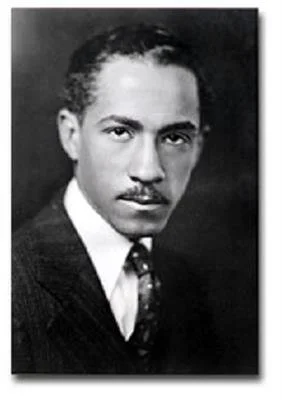
James Lesesne Wells (1902-1993)
An influential artist, printmaker, and educator, James Lesesne Wells played a pivotal role in advancing printmaking as a respected artistic medium within twentieth-century American art. Born in Atlanta, Georgia in 1902 and raised largely in Florida, Wells demonstrated early artistic promise, winning first prize in painting and second prize in woodworking at the Florida State Fair at the age of thirteen. This early recognition foreshadowed a career defined by both technical versatility and sustained innovation.
Wells pursued formal training at Lincoln University before continuing his studies at the National Academy of Design under George Luks, and later at Columbia University, where he majored in art education. During these formative years, he developed a wide-ranging visual vocabulary shaped by African sculptural traditions as well as European modernist movements, including German Expressionism, Cubism, and Fauvism. The work of artists such as Albrecht Dürer, Karl Schmidt-Rottluff, and Emil Nolde informed his approach to form, contrast, and expressive line, elements that would become central to his printmaking practice.
Although Wells worked across multiple media, printmaking quickly emerged as his primary mode of expression. His block prints, characterized by bold contrasts, rhythmic patterning, and a synthesis of modernist and African-derived forms, were widely published in influential periodicals such as Survey Graphic, Opportunity, and The Crisis, placing his work within the visual culture of the Harlem Renaissance. His growing reputation was affirmed through exhibitions, including a 1929 presentation of international modernists at the New Art Circle Gallery in New York.
Wells achieved early national recognition through the Harmon Foundation, receiving a Gold Medal in 1931 for Flight into Egypt and a first prize in 1933 for the woodcut Escape of the Spies from Canaan. These works exemplify his ability to merge biblical subject matter with a modernist visual language, using simplified forms and dynamic compositions to convey both narrative and symbolic meaning.
As an educator, Wells made an equally significant contribution. He joined the faculty at Howard University, where he taught ceramics, sculpture, metalwork, and printmaking. At a time when printmaking was often regarded as secondary to painting and sculpture, Wells advocated for its artistic legitimacy, ultimately helping to establish it within the university’s College of Fine Arts. His commitment to accessibility, both in terms of technique and audience, reflected a broader belief in the democratizing potential of the medium.
During the Depression, Wells served as director of what would become the Harlem Community Art Center, where he taught both children and adults, with artists such as Palmer Hayden and Georgette Seabrooke among his assistants. His dedication to printmaking deepened during this period, further refined through study with Frank Nankivell and a formative year at Stanley William Hayter’s Atelier 17, one of the most innovative printmaking workshops of the time.
Wells continued to produce both prints and paintings throughout his career, maintaining a practice that balanced formal rigor with expressive clarity. His work has been recognized in major exhibitions, including a solo presentation at the Smithsonian Institution in 1961 and a retrospective at Fisk University in 1973. Later exhibitions, such as the Washington Project for the Arts (1986), which traveled to the Studio Museum in Harlem, reaffirmed his lasting impact.
Today, Wells is recognized not only for his artistic achievements but also for his role in legitimizing printmaking as a vital and expressive form within African American art. His work stands as a testament to the power of line, form, and cultural synthesis, bridging modernist innovation with a deep engagement in history and narrative.
Selected Exhibitions
Exhibition of Paintings, Sculpture, and Pencil Drawings by JAMES LESESNE WELLS; New York Public Library, 135th St. Branch, NY, 1924
Lincoln University, Jefferson City, MO, 1924
Exhibition of Block Prints by JAMES LESESNE WELLS; New York Public Library, 135th St. Branch, NY, 1929
Harmon Foundation, NY, 1931, 1933, 1935
5th Annual Exhibition of American Block Prints; Print Club of Philadelphia, PA, 1931
Exhibition of Block Prints by JAMES LESESNE WELLS; Delphic Studios, NY, 1932
Howard University Gallery of Art, Washington, DC, 1938, 1959, 1965, 1922
American Negro Art, 19th and 20th Centuries; Downtown Gallery, NY, 1941-42
The Negro Artist Comes of Age: A National Survey of Contemporary American Artists; Albany Institue of History and Art, NY, 1945
Prints by JAMES L. WELLS; Division of Graphic Arts, Smithsonian Institution, Washington, DC, 1949
Prints and Paintings by JAMES L. WELLS; Carl Van Vechten Gallery, Fisk University, TN, 1966
Two Centuries of Black American Art; Los Angeles County Museum of Art, CA, 1976
JAMES LESESNE WELLS: Sixty Years in Art; Washington Project for the Arts, Washington, DC, 1987
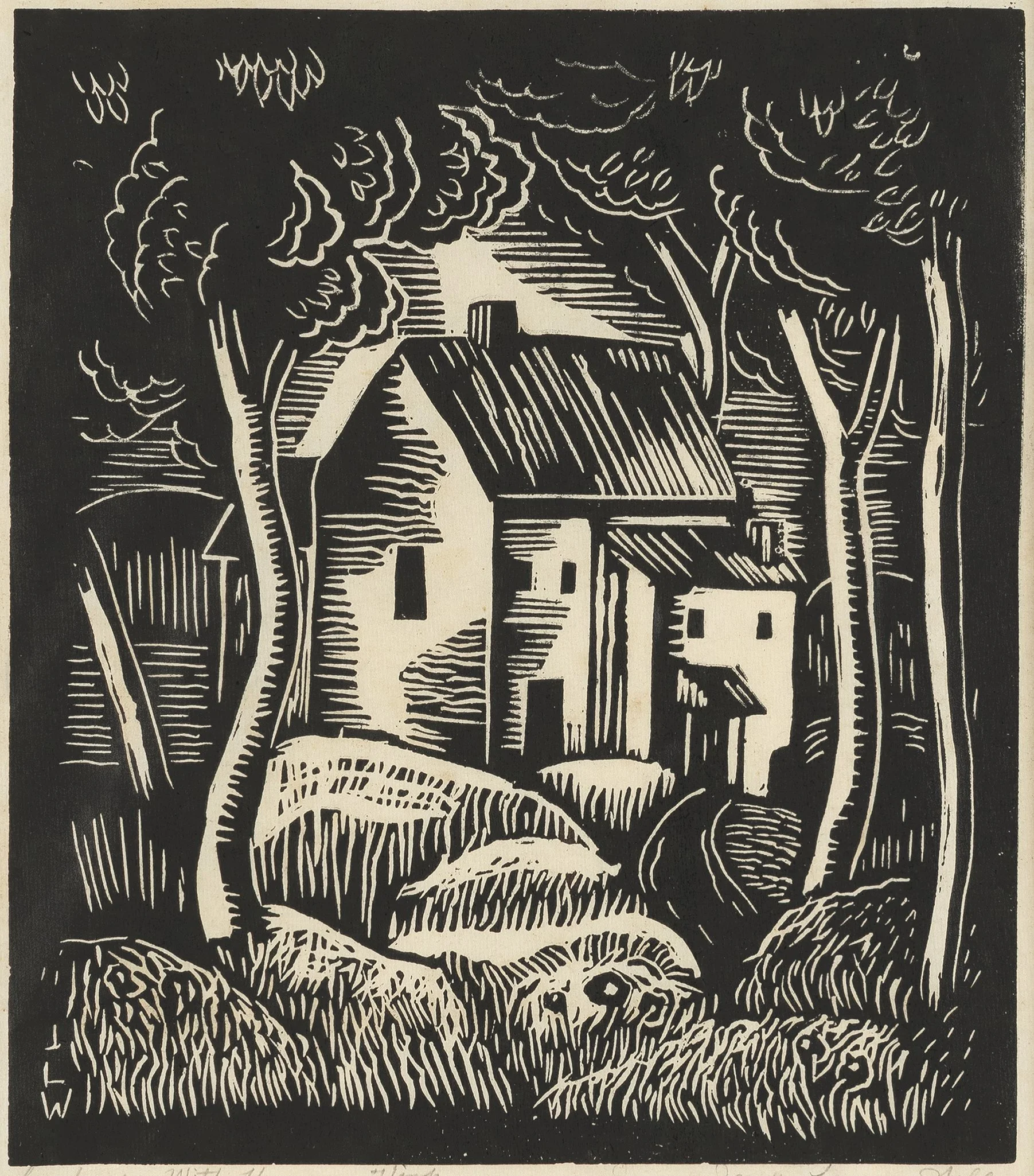
Landscape with House, 1945
linocut on cream paper
10-1/2 x 9 inches (image), full margins
signed, titled, and
inscribed, #1 impression in pencil