John Biggers (1924-2001)
Born in Gastonia, North Carolina in 1924, John Biggers developed one of the most complex and symbolically rich bodies of work in twentieth-century American art. His early training at the Hampton Institute in the 1940s, where he studied alongside artists such as Charles White and Elizabeth Catlett, grounded him in a social realist tradition that emphasized the dignity and labor of African American life. These early works, often focused on scenes of toil and endurance, laid the foundation for his later, more expansive visual language.
A pivotal shift occurred following his move to Houston in 1949, where he founded and chaired the art department at Texas State University for Negroes (now Texas Southern University). It was here that Biggers began to move beyond social realism, developing a highly structured, symbolic mode of representation. His 1957 UNESCO-sponsored journey to Ghana and Nigeria proved transformative, providing direct engagement with West African cultural and artistic traditions. From this point forward, his work increasingly synthesized African cosmology, Southern Black vernacular culture, and modernist design into a unified visual system.
A pivotal shift occurred following his move to Houston in 1949, where he founded and chaired the art department at Texas State University for Negroes (now Texas Southern University). It was here that Biggers began to move beyond social realism, developing a highly structured, symbolic mode of representation. His 1957 UNESCO-sponsored journey to Ghana and Nigeria proved transformative, providing direct engagement with West African cultural and artistic traditions. From this point forward, his work increasingly synthesized African cosmology, Southern Black vernacular culture, and modernist design into a unified visual system.
Across his mature oeuvre, Biggers constructed compositions that operate simultaneously as narrative, pattern, and spiritual diagram. Recurring motifs, shotgun houses, quilting patterns, trees of life, vessels, and maternal figures, function not merely as descriptive elements, but as carriers of cultural memory and continuity. His use of geometry is particularly significant: forms are carefully ordered into rhythmic, almost architectural arrangements, suggesting an underlying harmony that connects past and present, Africa and the American South, the individual and the collective.
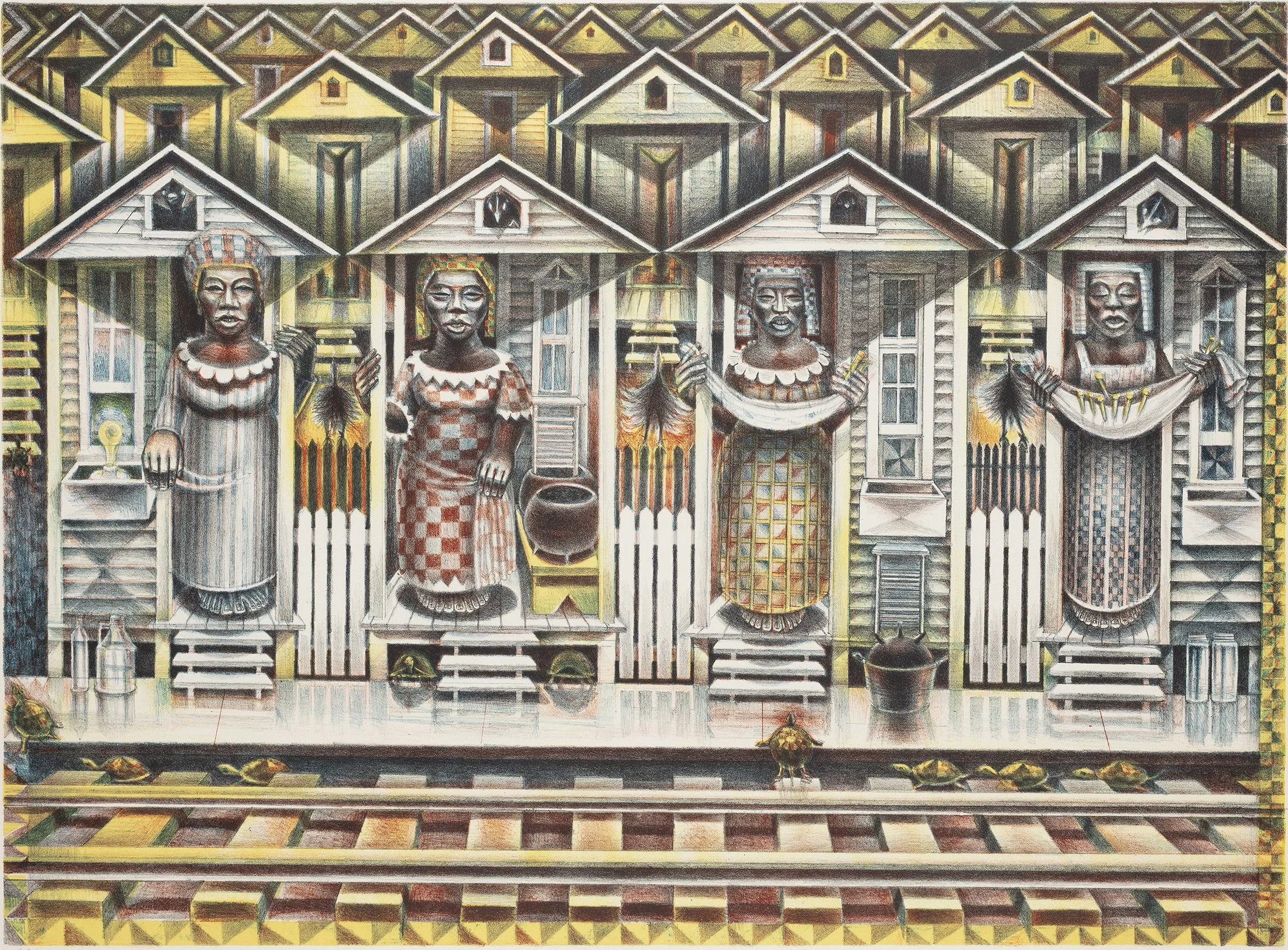
The present work exemplifies this synthesis with striking clarity. A repeating row of vernacular houses, reminiscent of Southern shotgun architecture, creates a rhythmic backdrop against which a series of monumental female figures stand in quiet procession. These figures, rendered with sculptural solidity and frontal stillness, evoke both ancestral presences and contemporary women, bridging temporal and cultural divides. Their garments, patterned with intricate, quilt-like designs, reinforce themes of continuity, craft, and communal identity. Below, the inclusion of railroad tracks introduces a subtle but powerful historical reference, suggesting movement, migration, and the layered journeys of African American experience. Turtles, also a recurring motif, function as mediators between realms, reinforcing the painting’s deeper spiritual architecture. Throughout, Biggers balances precision and warmth: the composition is tightly structured, yet animated by a luminous palette and intricate surface detail.
Biggers remained a deeply influential educator and cultural figure throughout his career, shaping generations of artists at Texas Southern University while continuing to produce murals, drawings, and paintings of remarkable complexity. He died in Houston in 2001. Today, his work is recognized not only for its aesthetic achievement, but for its profound articulation of a diasporic vision, one in which history, spirituality, and everyday life are woven into a cohesive and enduring whole.
Biggers’s work has been the subject of numerous exhibitions, including John Biggers: View from the Upper Room (Museum of Fine Arts, Houston, 1995) and Circle of Influence: The Art of John Biggers (Art Museum of South Texas, 2018), and has been featured in major thematic exhibitions such as Soul of a Nation: Art in the Age of Black Power (2017–2020).
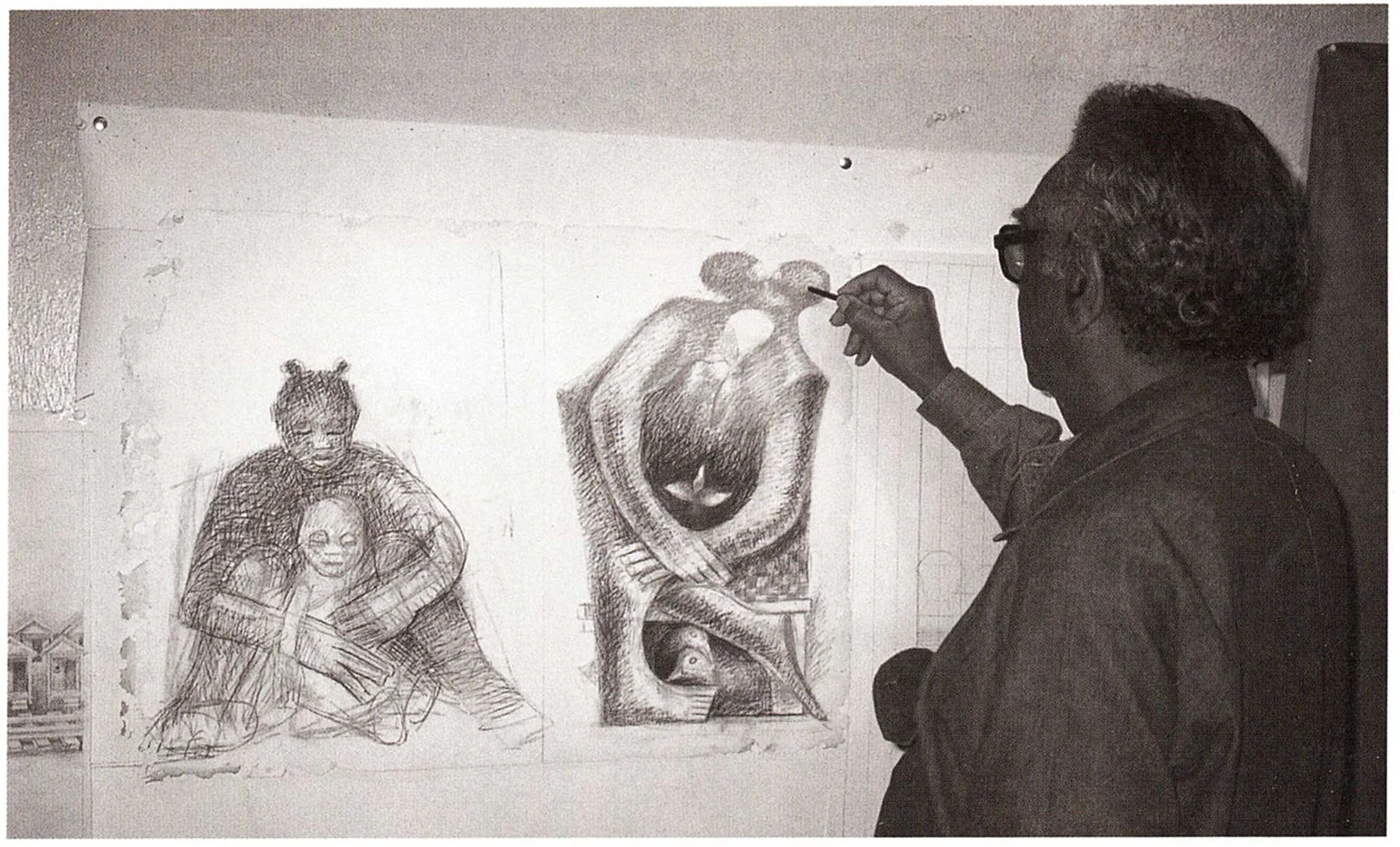
“I had a magnificent sense of coming home, of belonging,” he says - and he doesn’t mean it sentimentally.
“I recognized at once the Africanisms in our life in America, which we simply had not been able to recognize and to claim,” Biggers asserts. The sight of African men and women building their own houses, hewing and shaping their own ax handles, weaving their own quilts, making their own chairs, impressed him deeply. “And it reminded me of my own childhood times in North Carolina.”
Ann Holmes, It is Almost Genetic, The ARTGallery Magazine, April 1970, p. 38.
Four Seasons, 1990
color lithograph
25 x 33 inches
signed, numbered 29/120
Recent Exhibitions
Figures and Projections, Kutztown University, PA, 2021
Charles White: Influences; Rockland Center for the Arts, Nyack, NY, 2022
Queens, Gods, and Devotees; Frances M Maguire Art Museum, 2024
Claiming Freedom: Selections from the Petrucci Family Foundation Collection of African American Art; Lafayette College, Skillman Library, Easton, PA, 2024