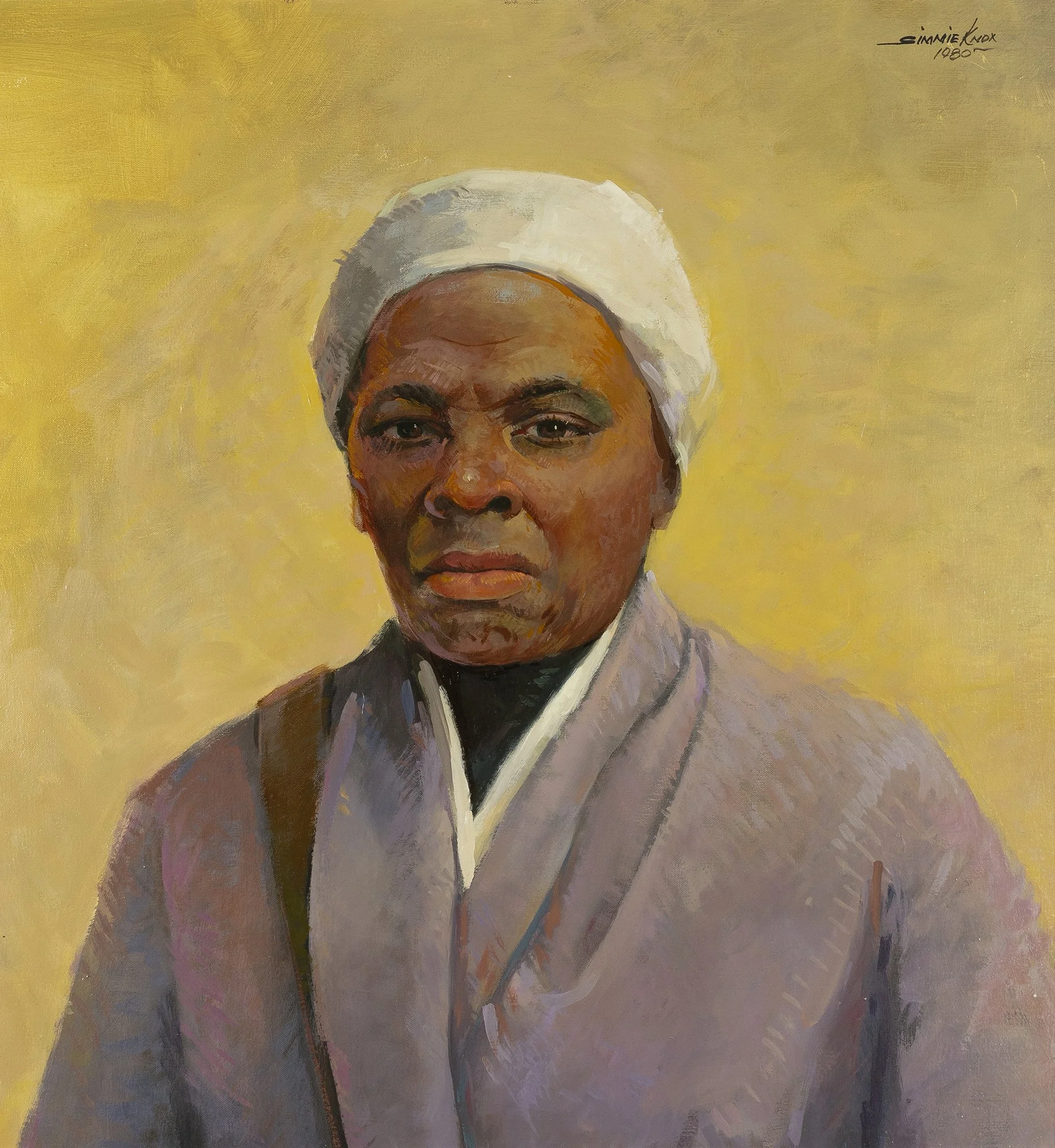
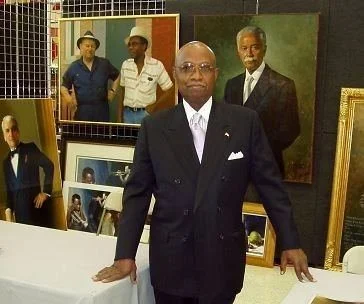
Born in Aliceville, Alabama in 1935, Simmie Knox emerged as one of the most accomplished portrait painters of his generation, though his artistic path began in a markedly different vein. Raised on a sharecropper’s farm in Leroy by his aunt and uncle, Knox found in art an early sense of purpose and refuge. He initially enrolled at Delaware State College to study biology before turning fully to art, later earning his MFA from the Tyler School of Art at Temple University in 1972. Settling in Washington, D.C., he entered a vibrant cultural landscape that would shape the trajectory of his career.
Knox first gained recognition in the 1970s as an abstract painter, producing works characterized by bold color and gestural energy. His inclusion in the Thirty-Second Biennial of Contemporary American Painting at the Corcoran Gallery of Art in 1971, as well as in the exhibition Black Artists/South at the Huntsville Museum of Art in 1979, signaled his early critical success. Yet by the late 1970s, he began to shift away from abstraction, drawn instead to the rigor and psychological demands of portraiture. This transition marked a decisive turning point: rather than abandoning his earlier sensibility, Knox carried forward its sensitivity to color and structure into a more representational mode.
Across his mature oeuvre, Knox has distinguished himself through an approach to portraiture that balances formal clarity with psychological presence. His subjects, often figures of cultural, political, or historical significance, are rendered with a directness that avoids both sentimentality and theatricality. Instead, Knox constructs images grounded in careful observation, allowing subtle shifts in expression, posture, and light to convey dignity, resilience, and individuality. His handling of paint, informed by his abstract beginnings, remains visible in the surface: brushwork is active yet controlled, contributing to a sense of vitality beneath the composed exterior.
Knox’s mastery of portraiture would ultimately bring him national recognition, most notably with his 2000 commission to paint the official White House portraits of President Bill Clinton and First Lady Hillary Rodham Clinton, the first such commission awarded to an African American artist. He has since portrayed a wide range of influential figures, including Muhammad Ali, Thurgood Marshall, and Ruth Bader Ginsburg. Across these works, Knox has remained committed to a vision of portraiture that affirms presence and humanity with quiet authority, securing his place within the broader tradition of American realist painting.
Simmie Knox
(b. 1935)
Selected Exhibitions
32nd Biennial Exhibition of Contemporary American Painting, Corcoran Gallery of Art, Washington, DC, 1971
Black Artists/South; Huntsville Museum of Art, AL, 1979
Holding Our Own: Selections from the Collectors Club of Washington DC; University of Maryland Art Gallery, College Park, MD, 2007
Celebrating 20 Years: Living Embodiments: Artistic Expressions of Being; Parish Gallery, Washington, DC, 2011
Simmie Knox, Morris T. Howard, Mason Archie; Parish Gallery, Washington, DC, 2012
Simmie Knox: Selected Works; Kreeger Museum, Washington, DC, 2025
Harriet Tubman, 1980
acrylic on canvas
26 x 24 inches
signed and dated